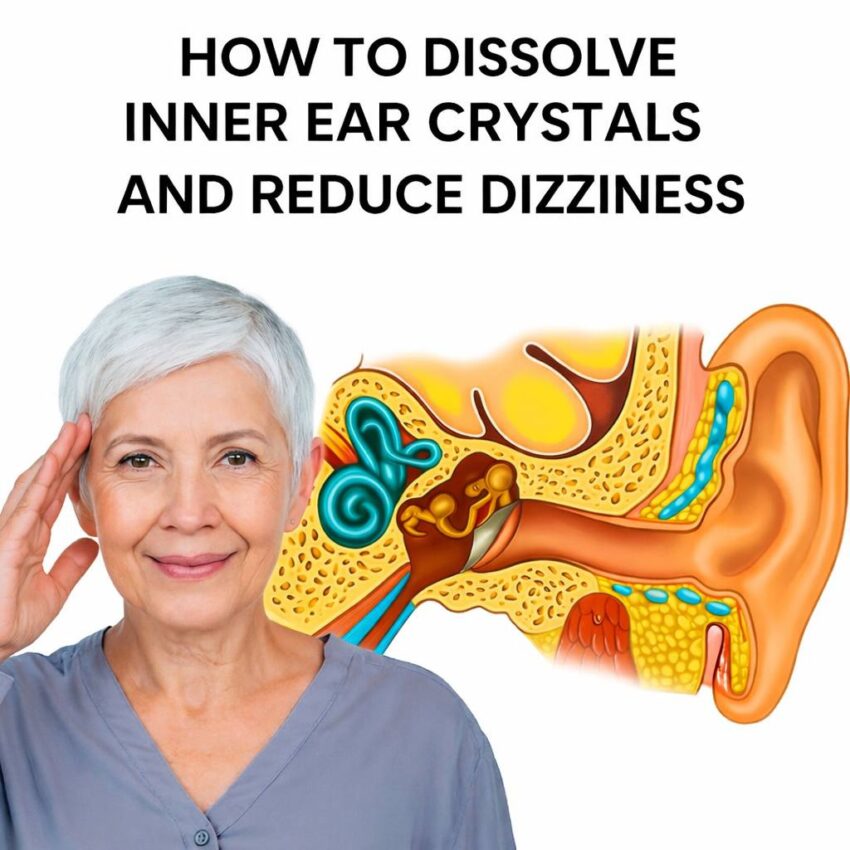
What people call “inner ear crystals” are tiny calcium particles involved in balance. When they move into the wrong part of the ear, they can trigger vertigo—most commonly a condition called Benign Paroxysmal Positional Vertigo.
The good news: this is often very treatable without medication.
🧠 What’s actually happening
In Benign Paroxysmal Positional Vertigo, crystals (otoconia) shift into the semicircular canals, confusing your brain about movement.
That’s why you feel spinning when you:
- Turn your head
- Roll in bed
- Look up or down
🏠 How to fix it (most effective method)
🔄 The Epley Maneuver
This is the main treatment used by doctors and physiotherapists.
Goal: move the crystals back where they belong.
Basic steps (for right ear – can vary):
- Sit upright, turn head 45° to the affected side
- Quickly lie back with head hanging slightly
- Wait ~30 seconds
- Turn head to the opposite side
- Roll onto your side
- Slowly sit up
📌 It’s best to:
- Learn the correct side first (important!)
- Do it with guidance initially if possible
🏥 Other helpful options
👨⚕️ Vestibular therapy
- Guided exercises from a specialist
- Helps retrain balance system
💊 Medications (short-term only)
- Anti-vertigo meds may reduce symptoms
- But they don’t fix the crystals
⚠️ What to avoid during episodes
- Sudden head movements
- Sleeping flat (use extra pillows briefly)
- Driving if dizzy
⏳ How long does it take?
- Many people improve in 1–3 sessions of the maneuver
- Some cases resolve within days
- Others may recur occasionally
🚨 When it might NOT be BPPV
Seek medical evaluation if you have:
- Hearing loss
- Ringing in ears
- Severe headache
- Weakness, numbness, or trouble speaking
These could suggest other conditions like **Meniere’s Disease or neurological issues.
🧠 Bottom line
- You don’t “remove” the crystals—you reposition them
- The Epley Maneuver is the most effective treatment
- Most cases are benign and very treatable
If you want, I can guide you step-by-step based on which side your vertigo happens on, or give a simple self-test to identify the affected ear.
