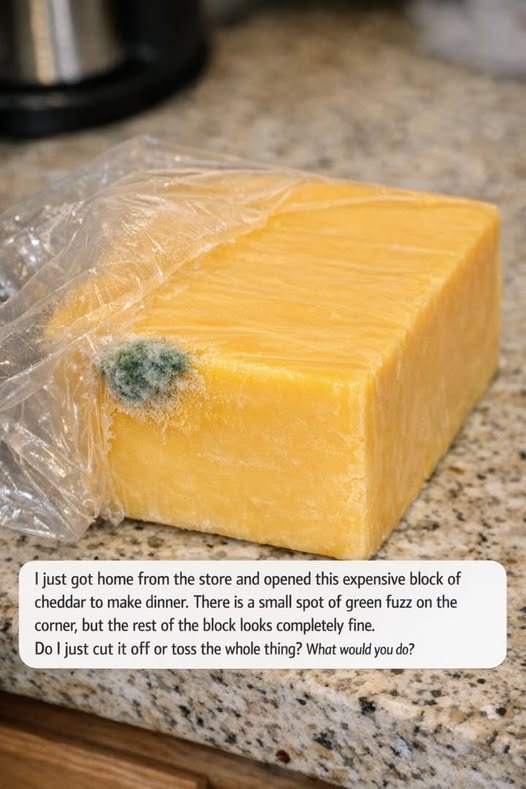
If you opened a block of Cheddar cheese and saw a small spot of green mold, it doesn’t always mean the whole block is ruined. Hard cheeses behave differently from soft ones.
What you can usually do with hard cheese 🧀
For firm cheeses like cheddar:
- Cut off the moldy area.
- Remove at least 1 inch (2.5 cm) around and below the mold spot.
- Use a clean knife so you don’t spread the mold spores.
- The rest of the cheese is generally safe to eat if it smells normal and looks fine.
Mold tends to stay on the surface of dense cheeses, so it usually doesn’t penetrate deeply.
When to throw it away ❌
Discard the whole block if:
- Mold is spread in multiple spots.
- The cheese feels slimy or smells strongly off.
- It’s a soft cheese like Brie or Cream cheese—mold can spread invisibly through those.
Why mold can appear
Mold on cheese is often from air exposure or moisture, not necessarily because the cheese is spoiled.
Quick storage tip
Wrap cheddar in parchment or wax paper first, then loosely in plastic and keep it in the refrigerator. This helps prevent mold from forming again.
✅ Bottom line:
For a hard cheese like cheddar, cut a generous area around the mold and the rest should be safe to use.
If you want, I can also show you 3 quick ways to tell in seconds whether cheese is actually spoiled or still good (they’re very useful in the kitchen). 🧀
